# Cultivation of Horticultural Crops in Hydroponic System
**Original Bangla Title**: হাইড্রোপনিক পদ্ধতিতে উদ্যানতাত্ত্বিক ফসলের চাষ
**Authors**: এ কে এম সেলিম রেজা মল্লিক (A. K. M. Salim Reza Mollik), ড. জি এম এ হালিম (Dr. G. M. A. Halim), ড. মো. আসাদুজ্জামান (Dr. Md. Asaduzzaman), ড. মো. আজমত উল্লাহ (Dr. Md. Azmat Ullah), ড. মোহাম্মদ আবু তাহের মাসুদ (Dr. Mohammad Abu Taher Masud), ড. ফেরদৌসী ইসলাম (Dr. Ferdousi Islam)
**Editors**: ড. আবুল কালাম আযাদ (Dr. Abul Kalam Azad — Director General, BARI), ড. মো. লুৎফর রহমান (Dr. Md. Lutfar Rahman — Director, Research Wing, BARI), মো. হাসান হাফিজুর রহমান (Md. Hasan Hafizur Rahman)
**Publisher**: Olericulture Division, Horticulture Research Centre (HRC), Bangladesh Agricultural Research Institute (BARI), Joydebpur, Gazipur-1701
**Publication Date**: June 2018 (জুন ২০১৮) | **Print Run**: 2,000 Copies (২০০০ কপি)
---
## Table of Contents (Strong Interlinking)
- [Front Matter, Foreword, Preface & Introduction to Hydroponics in Bangladesh (Pages i–viii & Page 1 (PDF Pages 1–10))](#ch-00)
- [Chapter 1: Principles of Crop Cultivation in Hydroponic System (Pages 2–3 (PDF Pages 11–12))](#ch-01)
- [Chapter 2: Seedling Production Techniques & Crop EC/pH Reference Chart (Pages 4–5 (PDF Pages 13–14))](#ch-02)
- [Chapter 3: Techniques of Preparing BARI Chemical Nutrient Solution (Stock A & Stock B) (Pages 6–8 (PDF Pages 15–17))](#ch-03)
- [Chapter 4: Operating Procedures & Structure Construction of Hydroponic Systems (Pages 9–11 (PDF Pages 18–20))](#ch-04)
- [Chapter 5 (Part A): Hydroponic Cultivation of Sweet Pepper (Capsicum) & Tomato (Pages 12–18 (PDF Pages 21–27))](#ch-05a)
- [Chapter 5 (Part B): Hydroponic Lettuce, Cucumber, Bitter Gourd & Strawberry Cultivation (Pages 18–27 (PDF Pages 27–36))](#ch-05b)
- [Chapter 5 (Part C): Hydroponic Bottle Gourd (Lau), Netted Melon & Marigold Flower (Pages 27–32 (PDF Pages 36–41))](#ch-05c)
- [Chapter 6: Soilless Vegetable & Fruit Cultivation in Coconut Coir Dust (Cocopeat) (Pages 33–34 (PDF Pages 42–43))](#ch-06)
- [Chapters 7 & 8: Vertical Hydroponic PVC Pipe System & 100 sq ft Micro-Garden Model (Pages 35–38 (PDF Pages 44–47))](#ch-07)
- [Chapter 9 & Conclusion: Key Precautions, Limitations & The 13-Element Deficiency Diagnostic Matrix (Pages 38–40 & Back Cover (PDF Pages 47–50))](#ch-09)
---
## Front Matter, Foreword, Preface & Introduction to Hydroponics in Bangladesh
*Pages i–viii & Page 1 (PDF Pages 1–10)*
### Foreword — Director General, BARI
Hydroponic culture is a modern and timely crop production technology that has been successfully used commercially across developed nations worldwide. Under controlled environments, diverse vegetables, fruits, and flowers can be cultivated on any fallow or non-arable space using this method. Because excess irrigation and synthetic chemical pesticides are generally not required in this system, the harvested produce is safe and residue-free. Cultivating high-market-value horticultural crops in this system is highly profitable. Countries across North America, Europe, Japan, Taiwan, China, Thailand, Singapore, Malaysia, and the Middle East commercially produce vegetables, fruits, and flowers through hydroponics. Year-round production is possible inside poly-tunnels, net-houses, or greenhouses. Scientists of the Olericulture Division, Horticulture Research Centre (HRC) at the Bangladesh Agricultural Research Institute (BARI) have conducted extensive research on hydroponic culture and successfully adapted protocols for vegetables, flowers, and fruit crops. I hope that adopting this technology will substantially meet both household and national vegetable and nutritional demands.
— **Dr. Abul Kalam Azad**, Director General, BARI (June 2018)
---
### Preface — Director (Research Wing), BARI
Bangladesh is a densely populated nation where rapid population growth is accompanied by a steady decline in arable agricultural land. Furthermore, climate change and global warming continuously threaten nature-dependent open-field agriculture. In this critical situation, developing alternative crop cultivation methods is imperative. Through dedicated research, the Olericulture Division of the Horticulture Research Centre at BARI has successfully cultivated **16 varieties of vegetable, flower, and fruit crops** using hydroponic technology. This publication serves as a practical technical manual for hydroponic crop production in Bangladesh.
— **Dr. Md. Lutfar Rahman**, Director (Research Wing), BARI
---
### Introduction (Book Page 1)
In Bangladesh, arable land per capita is extremely limited and shrinks every year due to new housing, roads, and industrial infrastructure. To feed a growing population, Bangladesh cannot rely solely on traditional field soil. Unused spaces, non-arable lands, and urban building rooftops must be brought under productive cultivation. In the hydroponic system, crops are produced under controlled conditions by supplying all essential plant nutrient elements dissolved directly in water.
The Olericulture Division of BARI has successfully produced **tomato, sweet pepper (capsicum), lettuce, cauliflower, broccoli, bitter gourd, dwarf country bean, cucumber, khira, strawberry, marigold, and rose** in large soilless galvanized steel or plastic trays filled with nutrient-enriched water. Because hydroponic strawberries never touch damp soil, fruit rot is eliminated. Moreover, waterlogged, coastal saline (Khulna/Satkhira), hilly, and flood-prone regions of Bangladesh can utilize hydroponics for year-round safe horticulture.
### 📸 Extracted BARI Book Figures & Photographs
- 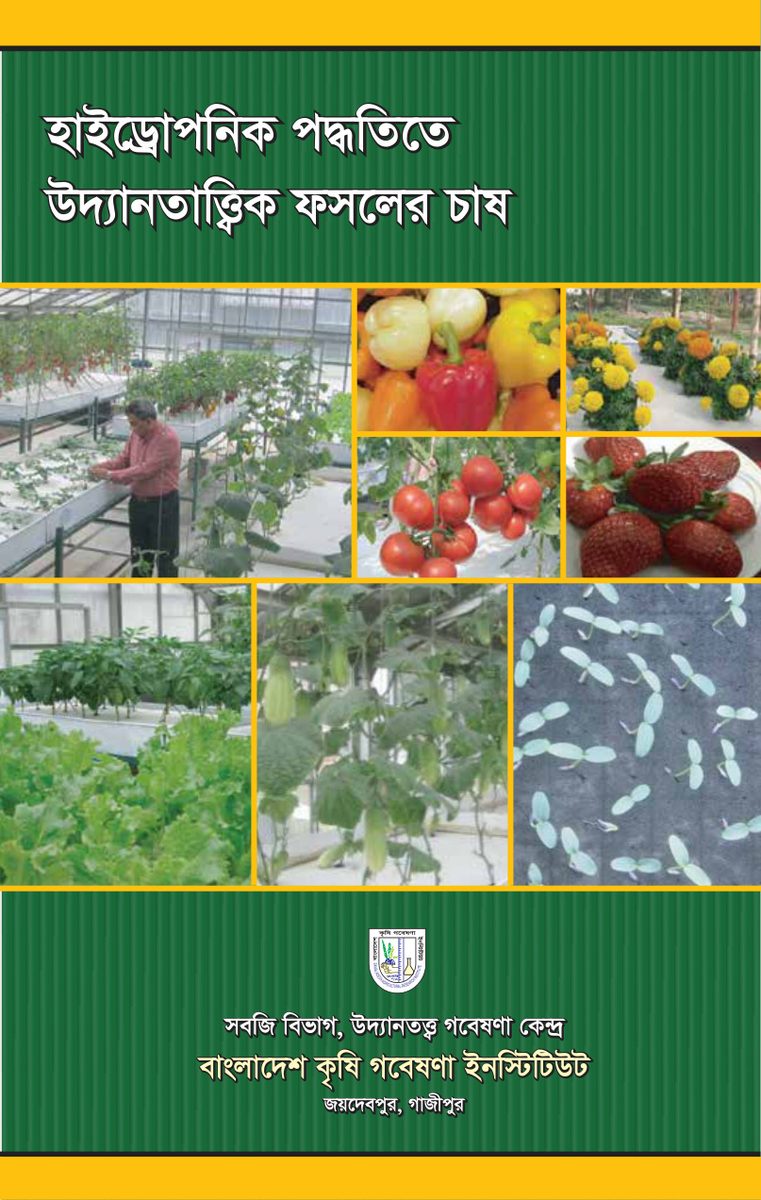
*Front Cover: Cultivation of Horticultural Crops in Hydroponic System (BARI, Gazipur)*
- 
*Dr. Abul Kalam Azad, Director General, Bangladesh Agricultural Research Institute (BARI)*
- 
*Dr. Md. Lutfar Rahman, Director (Research Wing), BARI*
- 
*Dr. G. M. A. Halim inspecting BARI hydroponic research trays at HRC Gazipur*
### 🔗 Interlinked Academy Courses & Tools on Hydroponics BD
- [Lesson 1.01: What Is Hydroponics? How Plants Grow Without Soil](https://hydroponics.com.bd/lesson-1-01-what-is-hydroponics-how-plants-grow-without-soil/)
- [Lesson 1.02: Soil vs. Hydroponics in Bangladesh](https://hydroponics.com.bd/lesson-1-02-soil-vs-hydroponics-in-bangladesh-yield-water-cost/)
- [Lesson 3.09: Hoagland vs. BARI Hydroponic Formula](https://hydroponics.com.bd/module-09-hoagland-solution-vs-bari-hydroponic-formula-tropical-adaptation/)
- [HydroGuide BD Nutrient Calculator (BARI Recipe Pre-Loaded)](https://hydroponics.com.bd/hydroguide/)
- [All 3 Open Hydroponics Courses (50 Lessons)](https://hydroponics.com.bd/academy/)
---
## Chapter 1: Principles of Crop Cultivation in Hydroponic System
*Pages 2–3 (PDF Pages 11–12)*
### Core Principle of Hydroponic Cultivation
The fundamental principle of cultivating vegetables, fruits, and flowers in a hydroponic system is supplying all essential plant nutrient elements dissolved in water inside galvanized steel or plastic trays, buckets, or bottles within a controlled environment.
### 9 Key Advantages of Hydroponic Crop Production
1. **No Arable Land Required**: Crops can be grown in any open or paved space without agricultural soil.
2. **Productive Use of Non-Arable Land**: Saline, barren, or concrete surfaces can be brought under cultivation.
3. **Combined Irrigation & Nutrition**: No separate field fertilizer broadcasting or flood irrigation is required.
4. **Zero Soil-Borne Pathogens or Nematodes**: Because it is 100% soilless, soil-borne bacterial wilt and root-knot nematodes are eliminated.
5. **Reduced Insect Pressure**: Controlled net-house/poly-tunnel environments drastically reduce pest attacks.
6. **Pesticide-Free Safe Food**: Minimal pest incidence allows 100% pesticide-free vegetable and fruit production.
7. **Year-Round & Off-Season Production**: High-value off-season crops can be grown 12 months a year.
8. **Hygienic & Scalable**: Suitable for both small household balconies and large commercial farms.
9. **Aesthetic Urban Gardening**: Enables flower and ornamental cultivation on apartment verandas and rooftops.
### Two Primary Methods of Hydroponic Operation
1. **(A) Circulating System**: Essential nutrients are mixed in a central reservoir tank and pumped through pipes into growing trays for **at least 7–8 hours daily**, aerating the root zone and recirculating excess solution. Although initial setup costs (trays, pump, piping) are incurred in Year 1, from Year 2 onward only chemical nutrient salts are needed.
2. **(B) Non-Circulating System (Passive Kratky Method)**: Plants are grown directly in a tray, plastic bucket, clay pot, or recycled water bottle filled with nutrient solution—requiring **zero pumps and zero electricity**. A critical **2 to 3 inch (5–8 cm) air gap** is maintained between the nutrient water surface and the cork-sheet (Styrofoam) lid, along with 4–5 small ventilation holes so upper roots absorb atmospheric oxygen directly.
### Table 1.1: Crops Cultivable in Hydroponic Systems in Bangladesh (BARI)
| Crop Category | Recommended Crops Tested by BARI |
| :--- | :--- |
| **Leafy Vegetables** | Lettuce, Gimakalmi (Water Spinach/Kangkong), Bilati Dhonia (Culantro/Coriander), Cabbage, Mint (Pudina) |
| **Fruit & Flower Vegetables** | Tomato, Brinjal (Eggplant), Sweet Pepper (Capsicum), Bitter Gourd (Korola), Cauliflower, Cucumber, Khira, Netted Melon, Bottle Gourd (Lau), Broccoli, Green Chili |
| **Fruits** | Strawberry, Lemon, Guava, Grape |
| **Flowers** | Marigold (Ganda), Anthurium, Rose, Orchid, Chrysanthemum (Chandramallika), Gerbera |
### 📸 Extracted BARI Book Figures & Photographs
- 
*BARI Hydroponic Sweet Pepper (Capsicum) harvested in Gazipur*
- 
*Lush Hydroponic Lettuce & Cucumber in BARI Tray System*
### 🔗 Interlinked Academy Courses & Tools on Hydroponics BD
- [Lesson 1.04: Exploring the 6 Basic Hydroponic Systems](https://hydroponics.com.bd/lesson-1-04-exploring-6-basic-hydroponic-systems-beginner-choice/)
- [Lesson 1.05: Building Your First Zero-Electricity Kratky Box](https://hydroponics.com.bd/lesson-1-05-building-first-zero-electricity-kratky-box-bangladesh/)
- [Lesson 2.01: Designing a Commercial NFT System](https://hydroponics.com.bd/lesson-2-01-designing-commercial-nft-nutrient-film-technique-system/)
- [HydroGuide BD Nutrient Calculator (BARI Recipe Pre-Loaded)](https://hydroponics.com.bd/hydroguide/)
- [All 3 Open Hydroponics Courses (50 Lessons)](https://hydroponics.com.bd/academy/)
---
## Chapter 2: Seedling Production Techniques & Crop EC/pH Reference Chart
*Pages 4–5 (PDF Pages 13–14)*
### Three Proven Seedling Production Methods (Book Pages 4–5)
Successful hydroponic cultivation depends heavily on raising vigorous, soil-free, disease-free seedlings. BARI recommends three standardized nursery techniques:
1. **Method 1: Sponge Block Nursery (`2.5 cm × 2.5 cm` Cubes)**
- Cut a polyurethane foam sponge sheet into `2.5 × 2.5 cm` square blocks and make a small slit in the center of each block to insert one seed.
- Once seeds sprout and develop 2–3 true leaves, add **20–30 mL** of nutrient solution A & B to the nursery tray every alternate day.
- Transplant into the main growing tray when seedlings are **20–25 days old**.
2. **Method 2: Washed Coconut Coir Dust (Cocopeat) in Earthen Dish (*Sanki*)**
- Wash an earthen dish thoroughly. In a separate bucket, wash raw coconut coir dust with clean water and sun-dry it for 1 day.
- Fill the earthen dish with washed cocopeat and sow seeds in rows. **For cucurbit seeds (cucumber, gourd, melon), always point the narrow tip of the seed downward and the thick end upward.** Sow other seeds horizontally at a depth equal to twice the seed's diameter.
3. **Method 3: Washed Coconut Coir Dust in Perforated Plastic Cups**
- Punch 4–5 large drainage holes in the bottom of a disposable plastic cup, fill with washed cocopeat, sow 1 seed in the center, and cover the top with moist newspaper. Remove the newspaper immediately upon germination and mist lightly every day.
---
### Table 2.1: BARI Standard EC & pH Reference Chart for 13 Hydroponic Crops
| Crop Name | Target EC Range (`dS/m` or `mS/cm`) | Target pH Range |
| :--- | :---: | :---: |
| **Tomato** | 2.0 – 2.5 | 6.0 – 6.5 |
| **Sweet Pepper (Capsicum) & Green Chili** | 1.8 – 2.2 | 6.0 – 6.5 |
| **Lettuce & Mint (Pudina)** | 0.8 – 1.2 | 6.0 – 7.0 |
| **Cucumber & Bitter Gourd (Korola)** | 1.7 – 2.5 | 5.5 |
| **Bottle Gourd (Lau)** | 1.8 – 2.4 | 5.5 – 7.5 |
| **Netted Melon** | 2.0 – 2.5 | 5.5 – 6.0 |
| **Sweet Potato** | 2.0 – 2.5 | 5.5 – 6.0 |
| **Okra (Dherosh)** | 2.0 – 2.4 | 6.5 |
| **Carrot** | 1.6 – 2.0 | 6.3 |
| **Lemon** | 1.0 – 1.6 | 5.5 – 6.5 |
| **Strawberry** | 1.8 – 2.2 | 6.0 |
| **Brinjal (Eggplant)** | 2.5 – 3.5 | 6.0 |
| **Marigold Flower** | 1.2 – 1.5 | 6.0 |
### 📸 Extracted BARI Book Figures & Photographs
- 
*Fig 2.1: Sowing seeds inside 2.5 × 2.5 cm Sponge Blocks*
- 
*Fig 2.2: Healthy seedlings emerging in Sponge Blocks*
- 
*Fig 2.3a: Washing earthen pot for cocopeat nursery*
- 
*Fig 2.3b: Preparing washed coconut coir dust in earthen dish (Sanki)*
- 
*Fig 2.4a: Perforating drainage holes at bottom of plastic nursery cup*
- 
*Fig 2.4b: Vigorous seedlings raised in cocopeat plastic pots*
### 🔗 Interlinked Academy Courses & Tools on Hydroponics BD
- [Lesson 1.06: Growing Media Guide for Bangladesh](https://hydroponics.com.bd/lesson-1-06-growing-media-guide-bangladesh-cocopeat-rice-husk-leca/)
- [Lesson 1.07: Seed Selection & High-Success Nursery Germination](https://hydroponics.com.bd/lesson-1-07-seed-selection-high-success-nursery-germination-guide/)
- [Lesson 1.10: How to Use a Digital pH Meter & TDS/EC Pen](https://hydroponics.com.bd/lesson-1-10-how-to-use-digital-ph-meter-and-tds-ec-pen/)
- [HydroGuide BD Nutrient Calculator (BARI Recipe Pre-Loaded)](https://hydroponics.com.bd/hydroguide/)
- [All 3 Open Hydroponics Courses (50 Lessons)](https://hydroponics.com.bd/academy/)
---
## Chapter 3: Techniques of Preparing BARI Chemical Nutrient Solution (Stock A & Stock B)
*Pages 6–8 (PDF Pages 15–17)*
### Required Equipment for Nutrient Preparation (Book Page 6)
1. Standard Rough Scale (1g–5kg capacity)
2. Electronic Precision Balance (0.01g accuracy for micronutrients)
3. Separate Weighing Boats / Vessels
4. Plastic/Non-metallic Spoons
5. Funnel
6. Two 10–12 Liter Opaque Plastic Jars/Drums (Labeled "Stock A" and "Stock B")
7. Permanent Marker Pen
8. 1,000 mL (1 Liter) Graduated Measuring Cylinder/Flask
9. Tissue Paper
---
### Table 3.1: Official BARI Chemical Formulation for 10 Liters of Stock Solution "A" & "B" (100x Concentrate)
> **Interactive Calculator Link**: This exact BARI formula is pre-loaded inside our **[HydroGuide BD Nutrient Calculator](/hydroguide/)**!
| Chemical Ingredient (Fertilizer Salt) | Chemical Formula | Exact Weight for 10L Stock (Grams) | Assigned Stock Tank |
| :--- | :--- | :---: | :---: |
| 1. Calcium Nitrate Tetrahydrate | `Ca(NO3)2·4H2O` | **1,000.00 g** | **Stock Solution "A"** |
| 2. Chelated Iron (EDTA-Fe 13%) | `EDTA-Fe` | **80.00 g** | **Stock Solution "A"** |
| 3. Mono Potassium Phosphate (MKP) | `KH2PO4` | **270.00 g** | **Stock Solution "B"** |
| 4. Potassium Nitrate | `KNO3` | **580.00 g** | **Stock Solution "B"** |
| 5. Magnesium Sulfate Heptahydrate (Epsom) | `MgSO4·7H2O` | **510.00 g** | **Stock Solution "B"** |
| 6. Manganese Sulfate Tetrahydrate | `MnSO4·4H2O` | **6.10 g** | **Stock Solution "B"** |
| 7. Boric Acid | `H3BO3` | **1.80 g** | **Stock Solution "B"** |
| 8. Copper Sulfate Pentahydrate | `CuSO4·5H2O` | **0.40 g** | **Stock Solution "B"** |
| 9. Ammonium Molybdate Tetrahydrate | `(NH4)6Mo7O24·4H2O` | **0.38 g** | **Stock Solution "B"** |
| 10. Zinc Sulfate Heptahydrate | `ZnSO4·7H2O` | **0.44 g** | **Stock Solution "B"** |
---
### Step-by-Step Mixing Protocol (Book Pages 7–8)
1. **Preparing 10 Liters of Stock Solution "A"**: Weigh **1,000 g Calcium Nitrate** and **80 g EDTA-Fe**. Dissolve Calcium Nitrate first in 10 Liters of clean water, then add EDTA-Fe and stir thoroughly using a **non-metallic rod** (plastic PVC pipe or wooden stick—never bare iron).
2. **Preparing 10 Liters of Stock Solution "B"**: Weigh the remaining 8 salts (`270g KH2PO4`, `580g KNO3`, `510g MgSO4`, `6.10g MnSO4`, `1.80g H3BO3`, `0.40g CuSO4`, `0.38g Ammonium Molybdate`, and `0.44g ZnSO4`) separately, dissolve each in warm water, and combine into 10 Liters of water to make Stock Solution "B".
3. **Diluting into the Working Reservoir (1:100 Dilution)**: To prepare **1,000 Liters** of working nutrient solution, first fill the reservoir tank with 1,000 Liters of clean water. Pour **10 Liters of Stock Solution "A"** into the water and stir thoroughly with a non-metallic rod. Then pour **10 Liters of Stock Solution "B"** into the tank and stir evenly (equivalent to **10 mL Stock A + 10 mL Stock B per 1 Liter of water**).
4. **Operating EC & pH Meters**: Maintain pH between **5.5 and 6.5**. Leafy crops absorb large amounts of `NO3-N`, causing pH to rise gradually. Lower high pH using diluted `H3PO4`, `HNO3`, or `HCl`; raise low pH using `KOH` or `NaOH`.
### 📸 Extracted BARI Book Figures & Photographs
- 
*Fig 3.1: Weighing Calcium Nitrate & EDTA-Fe for Stock Solution A*
- 
*Fig 3.2: Weighing 8 macro and micro salts for Stock Solution B*
- 
*Fig 3.3: Portable EC Meter used at BARI*
- 
*Fig 3.4: Portable pH Meter used at BARI*
### 🔗 Interlinked Academy Courses & Tools on Hydroponics BD
- [Launch HydroGuide BD Nutrient Calculator (Pre-loaded with BARI Formula)](https://hydroponics.com.bd/hydroguide/)
- [Lesson 1.09: Plant Food Made Simple — Tank A & Tank B](https://hydroponics.com.bd/lesson-1-09-plant-food-made-simple-tank-a-and-tank-b-liquid-nutrients/)
- [Lesson 3.02: Parts Per Million (ppm) & Fertilizer Stoichiometry](https://hydroponics.com.bd/module-02-parts-per-million-ppm-stoichiometry-nutrient-calculations/)
- [Lesson 3.03: Why Nutrients Are Split into Tank A & Tank B](https://hydroponics.com.bd/module-03-why-stock-solution-a-and-b-must-be-separated-precipitation/)
- [HydroGuide BD Nutrient Calculator (BARI Recipe Pre-Loaded)](https://hydroponics.com.bd/hydroguide/)
- [All 3 Open Hydroponics Courses (50 Lessons)](https://hydroponics.com.bd/academy/)
---
## Chapter 4: Operating Procedures & Structure Construction of Hydroponic Systems
*Pages 9–11 (PDF Pages 18–20)*
### Structure & Galvanized Tray Engineering (Book Pages 9–11)
Progressive farmers in Bangladesh can construct low-cost UV plastic-houses or poly-tunnels for year-round protected cultivation, or utilize residential rooftops and verandas.
#### BARI Standard Galvanized Steel Tray Specifications
- **Dimensions**: Fabricated from **18 to 24 gauge Galvanized Iron (GI) sheet** measuring **3.0 meters long × 90 cm wide × 20–25 cm deep**.
- **Anti-Corrosion White Coating**: Before use, paint the interior of metal trays with protective **white enamel/epoxy paint** so acidic nutrient salts never react with bare metal. **Never use rusted steel trays.**
- **Circulating vs. Non-Circulating Cork-Sheet Placement**: In circulating trays, the Styrofoam sheet floats directly on the 6–8 cm deep flowing solution. In non-circulating trays, metal support bars are placed 5 cm below the top rim to hold the Styrofoam lid while maintaining a **5–8 cm air gap** above the solution surface.
#### Operating Parameters
- **Circulating System**: Pump nutrient solution from the reservoir tank through the trays for **8–10 hours daily** to maintain high dissolved oxygen. Standard hole spacing on the cork-sheet: **Lettuce `20 × 20 cm`**, **Tomato `50 × 40 cm`**, and **Strawberry `30 × 30 cm`**. Maintain **6–8 cm** water depth and top up nutrients every **12–15 days**.
- **Non-Circulating System**: Requires zero electricity or pumps. Leave a **5–8 cm air gap** between the solution and cork-sheet lid, and drill **3–4 extra ventilation holes** in bucket/bottle lids for root respiration.
### 📸 Extracted BARI Book Figures & Photographs
- 
*Fig 4.1a: Padma Plastic Reservoir Tank connected to BARI Circulating Trays*
- 
*Fig 4.1b: Tomato cultivation in BARI Circulating Tray System*
- 
*Fig 4.2a: Marigold flower cultivation in Non-Circulating Tray*
- 
*Fig 4.2b: Tomato cultivation in Non-Circulating Tray*
### 🔗 Interlinked Academy Courses & Tools on Hydroponics BD
- [Lesson 2.02: Deep Water Culture (DWC) & Floating Raft Systems](https://hydroponics.com.bd/lesson-2-02-deep-water-culture-dwc-floating-raft-high-heat-regions/)
- [Lesson 2.05: Tropical Polyhouse & Shade-Net Structure Design](https://hydroponics.com.bd/lesson-2-05-tropical-polyhouse-shade-net-structure-design-bangladesh/)
- [HydroGuide BD Nutrient Calculator (BARI Recipe Pre-Loaded)](https://hydroponics.com.bd/hydroguide/)
- [All 3 Open Hydroponics Courses (50 Lessons)](https://hydroponics.com.bd/academy/)
---
## Chapter 5 (Part A): Hydroponic Cultivation of Sweet Pepper (Capsicum) & Tomato
*Pages 12–18 (PDF Pages 21–27)*
### 5.1 Sweet Pepper (Capsicum) Cultivation Protocol (Book Pages 12–15)
Per 100g of edible portion, sweet pepper contains 11 mg Calcium, 870 IU Vitamin A, and 175 mg Vitamin C.
- **Recommended Varieties**: `BARI Mistimorich-1`, `BARI Mistimorich-2`, and `California Wonder` (~160 seeds/gram; 230 g seed/ha).
- **Nursery Stage**: Pre-sprout seeds on moist tissue paper in a petri dish, transfer to `2.5 × 2.5 cm` sponge cubes floating in water, and feed 20–30 mL A+B daily at **EC 0.5–0.8 dS/m** from the 2–3 leaf stage. Transplant at **20–25 days**.
- **Tray & Bucket Planting**: Fill tray to 6–8 cm depth with 1 L Stock A + 1 L Stock B per 100 L water. Plant at **30 cm × 30 cm spacing**. In plastic buckets, maintain a **1-inch (2.54 cm) air gap** between the stem base and solution so 1/3 of roots sit in water and 2/3 in humid air.
- **Iron Chlorosis Correction & Flowering EC**: If upper leaves turn yellow during vegetative growth, dissolve **5 g EDTA-Fe in 1 Liter water** and apply **200 mL per 100 Liters of reservoir water**. At flowering, maintain **EC 2.0–2.5 dS/m** and **pH 6.0–6.5**, supporting stems with overhead twine.
- **Yield & Cost-Return Analysis (`3m × 1m` Tray = 36 Plants)**:
- Harvest begins 55–60 days after transplanting (12–15 days earlier than soil). Yield is **800–1,200 g/plant** (**60–70 tons/ha** vs. 20–25 tons/ha in soil).
- **Total Cost per Tray**: Nutrient Solution `৳800` + Cork Sheet `৳300` + Other `৳600` = **`৳1,700`**.
- **Gross Return**: 36 plants × 1.0 kg = 36 kg × `৳100/kg` = **`৳3,600`**.
- **Net Profit per `3m²` Tray**: **`৳1,900`**.
---
### 5.2 Hydroponic Tomato Cultivation Protocol (Book Pages 15–18)
- **Recommended Varieties**: `BARI Tomato-14`, `BARI Hybrid Tomato-4` (Summer), and `BARI Hybrid Tomato-10` (bacterial wilt resistant, 90–95g fleshy fruit, 45–60 day harvest window).
- **Tray & Bucket Management**: In a `3m × 1m` tray, plant **24 seedlings** at `30 cm × 30 cm` spacing (3x field density). In plastic buckets, mix 10 mL Stock A + 10 mL Stock B per liter of water leaving a 6–8 cm top gap and 2–3 aeration holes in the lid. Maintain **EC 2.0–2.5 dS/m** and **pH 6.0–6.5** during fruiting.
- **Yield & Cost-Return Analysis (`3m × 1m` Tray = 24 Plants)**:
- Each plant yields 25–30 fruits (**3.75–4.80 kg/plant**, averaging **4.25 kg/plant**; **120–130 tons/ha** vs. 90–95 tons/ha in soil).
- **Total Cost per Tray**: Nutrient Solution `৳600` + Cork Sheet `৳300` + Labor/Other `৳500` = **`৳1,400`**.
- **Gross Return**: 24 plants × 4.25 kg = 102 kg × `৳25/kg` = **`৳2,550`**.
- **Net Profit per `3m²` Tray**: **`৳1,150`**.
### 📸 Extracted BARI Book Figures & Photographs
- 
*Fig 5.1: BARI Sweet Pepper (Capsicum) Varieties*
- 
*Fig 5.2: Sowing Capsicum seeds in Sponge Blocks*
- 
*Fig 5.3: 20-day-old Capsicum seedlings in BARI tray*
- 
*Fig 5.4: Harvest-ready Capsicum crop in BARI Hydroponic House*
- 
*Fig 5.5: BARI Tomato-14 grown in hydroponic system*
- 
*Fig 5.6: Tomato seedling ready for transplanting*
- 
*Fig 5.7: Tomato seedlings transplanted into 3m × 1m tray*
- 
*Fig 5.8: Planting tomato in a 10L plastic bucket with air gap*
- 
*Fig 5.9: Supporting tomato plants upright with plastic twine*
### 🔗 Interlinked Academy Courses & Tools on Hydroponics BD
- [Lesson 2.07: Commercial Hydroponic Tomato Production](https://hydroponics.com.bd/lesson-2-07-commercial-hydroponic-tomato-production-bari-hybrid-cherry/)
- [Lesson 2.08: Commercial Colored Bell Pepper (Capsicum) Production](https://hydroponics.com.bd/lesson-2-08-commercial-colored-bell-pepper-capsicum-production/)
- [HydroGuide BD Nutrient Calculator (BARI Recipe Pre-Loaded)](https://hydroponics.com.bd/hydroguide/)
- [All 3 Open Hydroponics Courses (50 Lessons)](https://hydroponics.com.bd/academy/)
---
## Chapter 5 (Part B): Hydroponic Lettuce, Cucumber, Bitter Gourd & Strawberry Cultivation
*Pages 18–27 (PDF Pages 27–36)*
### 5.3 Hydroponic Lettuce Cultivation (Book Pages 18–20)
- **Varieties**: `BARI Lettuce-1`, `Grand Rapids`, `Green Wave`, `Salina`, and `Rex`.
- **Cultivation Protocol**: Surface-sterilize seeds with 10% calcium/sodium hypochlorite before sowing in `2.5 × 2.5 cm` sponge cubes. Transplant 2–3 week old seedlings at **30 × 30 cm** spacing. Start at **pH 5.8–6.5** and **EC 1.5–1.9 dS/m**, increasing to **EC 2.0–2.2 dS/m** after 10–15 days.
- **Harvest & Multi-Cycle Reuse**: Harvest in **20 to 35 days** at **400–600 g per head**. Remarkably, during the cool winter season, **2 to 3 consecutive lettuce crops** can be grown in the same nutrient solution batch! Never apply chemical pesticides on salad lettuce.
---
### 5.4 Hydroponic Cucumber Cultivation (Book Pages 20–21)
- **Varieties**: Short-internode, high female-flower cultivars: `Jasmine`, `Alavi`, `Sufala`, and `Baromashi`.
- **Protocol & Yield**: Transplant 10–15 day old seedlings at **50 × 50 cm** spacing. Maintain **pH 5.8–6.2** and **EC 1.5–1.8 dS/m** vegetatively, rising to **EC 2.0–2.2 dS/m** at flowering (20–25 days). Harvest at 40–45 days: **1.5–2.5 kg/plant** (5–7 fruits) in circulating trays and **1.5–2.0 kg/plant** in non-circulating containers. Hand pollination significantly boosts yield.
---
### 5.5 Hydroponic Bitter Gourd (*Korola*) Cultivation (Book Pages 22–24)
- **Varieties**: `BARI Korola-1`, `Tiya`, `Kakoli`, `Taj`, `Green Arrow`, `Shuktara`, and `Gaj Korola`.
- **Protocol & Economics (`2m × 1m` Tray = 12 Plants at `60 × 30 cm`)**:
- Maintain **EC 1.5–2.0 dS/m** and **pH 6.0–6.5** at flowering. Use Cuelure pheromone traps for cucurbit fruit flies.
- **Yield**: 10–15 fruits/plant (**2.0–3.5 kg/plant**, averaging 2.5 kg; **50–60 tons/ha** vs. 20–25 tons/ha in soil), harvesting 10–15 days earlier than soil crops.
- **Cost-Return**: Cost = `৳450` (`৳200` solution + `৳150` cork-sheet + `৳100` other); Gross Return = 30 kg × `৳30/kg` = `৳900`; **Net Profit = `৳450` per `2m²` tray** (`৳225/m²`).
---
### 5.6 Hydroponic Strawberry Cultivation (Book Pages 25–27)
- **Variety & Climate**: `BARI Strawberry-1`. Optimal temperature: **20–26°C day** and **12–16°C night**. Plant between **mid-September and mid-October**.
- **Runner Pruning & EC/pH**: Propagate via rooted runners or tissue-culture plantlets. Maintain **EC 1.5–1.9 dS/m (pH 5.5–6.0)** at planting and **EC 2.0–2.5 dS/m** after 1 month. **Prune emerging stolon runners every 10–15 days** to direct energy into fruit production.
- **Cost-Return (`3m × 1m` Tray = 36 Plants)**:
- **Yield**: 30–35 berries/plant (**300–400 g/plant**) harvested December–February.
- **Cost**: `৳1,700` (`৳800` solution + `৳300` cork-sheet + `৳600` other); **Return**: 14.4 kg × `৳200/kg` = `৳2,880`; **Net Profit = `৳1,180` per `3m²` tray**.
### 📸 Extracted BARI Book Figures & Photographs
- 
*Fig 5.10: Hydroponic Lettuce cultivation in BARI Tray*
- 
*Fig 5.11: Hydroponic Cucumber cultivation on overhead trellis*
- 
*Fig 5.12: Bitter Gourd (Korola) fruiting in hydroponic tray*
- 
*Fig 5.13: Bitter Gourd grown in non-circulating plastic buckets*
- 
*Fig 5.14: Harvested BARI Hydroponic Bitter Gourd*
- 
*Fig 5.15: Transplanting Strawberry into BARI Hydroponic Tray*
- 
*Fig 5.16: Fruiting Strawberry in BARI Tray*
- 
*Fig 5.17: Freshly harvested mud-free BARI Strawberries*
### 🔗 Interlinked Academy Courses & Tools on Hydroponics BD
- [Lesson 1.12: Growing Lettuce, Mint, Coriander & Spinach in 30 Days](https://hydroponics.com.bd/lesson-1-12-first-crop-guide-lettuce-mint-coriander-spinach-30-days/)
- [Lesson 2.09: Commercial Cucumber & Rockmelon Production](https://hydroponics.com.bd/lesson-2-09-commercial-english-seedless-cucumber-rockmelon-production/)
- [Lesson 2.10: Commercial Strawberry Production](https://hydroponics.com.bd/lesson-2-10-commercial-strawberry-production-vertical-a-frames-gutters/)
- [HydroGuide BD Nutrient Calculator (BARI Recipe Pre-Loaded)](https://hydroponics.com.bd/hydroguide/)
- [All 3 Open Hydroponics Courses (50 Lessons)](https://hydroponics.com.bd/academy/)
---
## Chapter 5 (Part C): Hydroponic Bottle Gourd (Lau), Netted Melon & Marigold Flower
*Pages 27–32 (PDF Pages 36–41)*
### 5.7 Hydroponic Bottle Gourd (*BARI Lau-4*) — 6-Step Bucket Protocol (Book Pages 27–29)
- **Variety & Season**: `BARI Lau-4` (October to January).
- **6-Step Bucket Cultivation Method**:
1. Drill a 1-inch radius central hole in the lid/cork-sheet of a 10-Liter plastic bucket, plus a `1 × 2 inch` side aeration slot.
2. Fill the bucket with **8 Liters of water** and mix **80 mL Stock A + 80 mL Stock B** (10 mL/L).
3. Transplant a 15–20 day old sponge seedling so **1/3 of the roots touch the solution** and the upper roots stay in air.
4. Maintain **EC 1.5–2.0 dS/m** and **pH 6.0–6.5**. Stir the bucket water with a wooden stick every 1–2 days for aeration, and replace the solution completely after 30 days.
5. Trellis the vine with nylon rope; flowering starts at 30–35 days and first harvest at 45–50 days (top up nutrients every 7 days during fruiting).
6. Harvest **3 to 5 bottle gourds per bucket** (15–20 days after female flower pollination).
- **Bucket Economics**: Total Cost = `৳130–150` (`৳50` nutrients + `৳80` bucket share); Gross Return = 5 gourds × `৳50` = `৳250`; **Net Profit = `৳100–120` per bucket**.
---
### 5.8 Hydroponic Netted Melon Cultivation (Book Page 29)
- **Planting & Exclusion Netting**: Transplant 10–15 day old seedlings in November–December at **EC 1.0–1.5 dS/m**. Enclose the tray/canopy inside a fine white insect net to completely block cucurbit fruit flies.
- **Fruit Thinning & Maturity**: Retain only **2 to 3 fruits per vine**, suspending each melon in a nylon net hammock tied to the overhead wire. Harvest when the raised corky skin netting is complete, the adjacent tendril dries, and a sweet aroma develops (**500–1,000 g per fruit** with pink-yellow flesh).
---
### 5.9 Hydroponic Marigold (*Inca-1*) Flower Cultivation (Book Pages 30–32)
- **Variety & EC/pH**: `Inca-1` yellow/orange marigold planted in September–October. Maintain **EC 0.75–1.0 dS/m (pH 5.5–6.0)** during Month 1, and **EC 1.0–1.5 dS/m (pH 5.5–6.2)** during flowering (November–February). Each 25–30 cm plant produces **10–20 large blooms (9–10 cm diameter)**.
### 📸 Extracted BARI Book Figures & Photographs
- 
*Fig 5.18: Bottle Gourd (Lau) seedlings in Sponge Blocks*
- 
*Fig 5.19: Planting Bottle Gourd seedling in 10L plastic bucket lid*
- 
*Fig 5.20: Replacing nutrient solution in Bottle Gourd bucket after 30 days*
- 
*Fig 5.21: Harvest-ready BARI Lau-4 grown in hydroponic buckets*
- 
*Fig 5.22: Netted Melon suspended in tray system at BARI*
- 
*Fig 5.23: Fully netted mature Hydroponic Melon*
- 
*Fig 5.24: Inca-1 Marigold flowers blooming in plastic buckets*
- 
*Fig 5.25: Performance trial of Marigold at different EC levels in BARI trays*
### 🔗 Interlinked Academy Courses & Tools on Hydroponics BD
- [Lesson 1.05: Building Your First Zero-Electricity Kratky Bucket](https://hydroponics.com.bd/lesson-1-05-building-first-zero-electricity-kratky-box-bangladesh/)
- [Lesson 2.09: Commercial Cucumber & Netted Rockmelon Production](https://hydroponics.com.bd/lesson-2-09-commercial-english-seedless-cucumber-rockmelon-production/)
- [HydroGuide BD Nutrient Calculator (BARI Recipe Pre-Loaded)](https://hydroponics.com.bd/hydroguide/)
- [All 3 Open Hydroponics Courses (50 Lessons)](https://hydroponics.com.bd/academy/)
---
## Chapter 6: Soilless Vegetable & Fruit Cultivation in Coconut Coir Dust (Cocopeat)
*Pages 33–34 (PDF Pages 42–43)*
### Substrate Cultivation in Washed Coconut Coir Dust / Cocopeat (Book Pages 33–34)
In addition to water culture, crops can be grown in solid substrates including coconut coir dust (cocopeat), vermiculite, gravel, sawdust, and carbonized rice husk.
- **BARI Siphon-Hole Pot Design**: Drill a drainage hole **1.5 inches (3.8 cm) above the bottom** of the plastic pot/drum and fit a narrow drainage pipe (creating an internal moisture reservoir at the base, identical in principle to a Dutch Bucket!). Wash the cocopeat thoroughly, sun-dry for 1 day, and fill the pot.
- **Feeding Schedule**: Water with plain water for the first 3–5 days after transplanting, then apply **500–600 mL of working nutrient solution (A+B) per plant once a week** (plus plain water as needed). Yields **2.5–3.0 kg Tomato** or **1.0–1.2 kg Capsicum** per pot.
#### Special Crop Protocols in Cocopeat
1. **Green Chili in Cocopeat Pots**: Flowers in 30–35 days and yields **1.0–1.5 kg of fresh chili per pot**.
2. **Sweet Potato (Dual Leafy Greens & Root Tuber Crop)**: Fill a `1m × 1m` tray with a **10–15 cm deep layer** of washed cocopeat. In November, plant **20–25 cm sweet potato vine cuttings** at `30 × 30 cm` spacing. Feed A+B solution every 2 days. Tender vine tips can be harvested as nutritious leafy greens, and after **100–120 days**, each plant yields **1.5–2.0 kg of clean, mud-free sweet potato tubers**!
3. **Potted Lemon Trees in Cocopeat**: Plant rooted lemon cuttings in cocopeat drums; flowering begins in 2–3 months, yielding **50–60 lemons per pot per season**.
### 📸 Extracted BARI Book Figures & Photographs
- 
*Fig 6.1: Tomato & Capsicum grown in washed cocopeat containers*
- 
*Fig 6.2: Mint (Pudina) flourishing in cocopeat tray*
- 
*Fig 6.3: Green Chili cultivation in cocopeat pot*
- 
*Fig 6.4: Sweet Potato vine & leafy greens in 1m × 1m cocopeat tray*
- 
*Fig 6.5: Harvesting 1.5–2.0 kg tuberous Sweet Potatoes from cocopeat!*
- 
*Fig 6.6: Year-round Lemon cultivation in cocopeat half-drums*
### 🔗 Interlinked Academy Courses & Tools on Hydroponics BD
- [Lesson 1.06: Growing Media Guide — Washing & Buffering Cocopeat](https://hydroponics.com.bd/lesson-1-06-growing-media-guide-bangladesh-cocopeat-rice-husk-leca/)
- [Lesson 2.03: Dutch Bucket & Cocopeat Drip Systems](https://hydroponics.com.bd/lesson-2-03-dutch-bucket-bato-bucket-drip-systems-fruiting-crops/)
- [Lesson 3.10: Cocopeat Buffering & Cation Exchange Capacity (CEC)](https://hydroponics.com.bd/module-10-cocopeat-buffering-cation-exchange-capacity-cec-protocol-bangladesh/)
- [HydroGuide BD Nutrient Calculator (BARI Recipe Pre-Loaded)](https://hydroponics.com.bd/hydroguide/)
- [All 3 Open Hydroponics Courses (50 Lessons)](https://hydroponics.com.bd/academy/)
---
## Chapters 7 & 8: Vertical Hydroponic PVC Pipe System & 100 sq ft Micro-Garden Model
*Pages 35–38 (PDF Pages 44–47)*
### Chapter 7: Vertical Hydroponic PVC Pipe System (Book Pages 35–36)
Arranging one or more horizontal growing layers vertically to multiply crop output on a tiny footprint is called **Vertical Hydroponics**, increasing plant density by **3x to 8x per square meter** with a structure lifespan of **5–7 years**.
- **BARI 6-Foot × 5-Inch PVC Pipe Construction Blueprint**:
- Take **six 6-foot-long (5-inch diameter) PVC pipes** and seal both open ends of each pipe with circular cut cork-sheet/end-caps.
- Along the top of each pipe, drill **six `1.5-inch` diameter holes** (for planting seedlings) and **four `0.5-inch` diameter holes** (for air circulation)—**10 holes total per pipe**.
- Plant 6 high-value crops (Capsicum, Lettuce, Strawberry, Summer Tomato, Chili, or Brinjal) per pipe.
- Fill each pipe with **10–20 Liters of working nutrient solution**, topping up 2–3 Liters every 15 days.
- **Unit Economics per 6-Foot Pipe**: Each pipe requires only `৳20` of chemical nutrient solution (`৳30` total operating cost per cycle) and produces **`৳150` worth of fresh cucumber, strawberry, or lettuce** (a **5x return** on operating cost!).
---
### Chapter 8: The 100 sq ft Household Micro-Garden Model (Book Pages 37–38)
- **Model Specification**: A **10 ft × 10 ft (100 sq ft) mini polyhouse** utilizing recycled household containers (5L cooking oil bottles, beverage bottles, plastic pots) filled with water solution or washed cocopeat to supply year-round pesticide-free vegetables for a **2 to 3 member family**.
- **16 Suitable Crops**: Tomato, Capsicum, Cauliflower, Cucumber, Bitter Gourd, Coriander, Strawberry, Lettuce, Green Chili, Bottle Gourd, Red Amaranth (*Lal Shak*), Radish, Mint, Sweet Potato, Potato, and Onion.
- **Setup Cost & Annual Return**:
- Poly-tunnel frame & cover: `৳3,000` + Nutrient solution & containers: `৳2,000` = **`৳5,000` total setup cost** (lasts 2–3 years).
- Produces `৳2,000–3,000` of vegetables per season = **`৳6,000` of safe family vegetables per year**.
### 📸 Extracted BARI Book Figures & Photographs
- 
*Fig 7.1: Multi-tier Vertical Hydroponic vegetable cultivation at BARI*
- 
*Fig 7.2: Farmers & trainees inspecting BARI Vertical PVC Pipe System*
- 
*Fig 8.1: 10 ft × 10 ft (100 sq ft) BARI Micro-Garden Polyhouse Model*
- 
*Fig 8.2: Inside the Micro-Garden: recycled oil bottles and plastic crates*
- 
*Fig 8.3: Lush family vegetables growing inside the 100 sq ft Micro-Garden*
### 🔗 Interlinked Academy Courses & Tools on Hydroponics BD
- [Lesson 1.02: Soil vs. Hydroponics Space & Cost Efficiency](https://hydroponics.com.bd/lesson-1-02-soil-vs-hydroponics-in-bangladesh-yield-water-cost/)
- [Lesson 2.14: Commercial Farm Economics in Bangladesh (CAPEX/OPEX/ROI)](https://hydroponics.com.bd/lesson-2-14-commercial-farm-economics-bangladesh-capex-opex-roi/)
- [HydroGuide BD Nutrient Calculator (BARI Recipe Pre-Loaded)](https://hydroponics.com.bd/hydroguide/)
- [All 3 Open Hydroponics Courses (50 Lessons)](https://hydroponics.com.bd/academy/)
---
## Chapter 9 & Conclusion: Key Precautions, Limitations & The 13-Element Deficiency Diagnostic Matrix
*Pages 38–40 & Back Cover (PDF Pages 47–50)*
### Chapter 9: 7 Golden Precautions for Hydroponic Success (Book Pages 38–39)
1. **Strict EC & pH Control**: Keep solution **pH between 5.8 and 6.5** and **EC between 1.5 and 2.5 dS/m**. Deviations outside this range severely damage plant roots.
2. **Avoid Sudden Shocks**: Never change the pH or EC of the working nutrient solution abruptly during active vegetative growth.
3. **Visual Deficiency Monitoring**: Inspect leaf color and plant vigor daily to spot early nutrient imbalances and supplement accordingly.
4. **Maintain Ideal Solution Temperature (`25–30°C`)**: Keep nutrient water between **25°C and 30°C**. When afternoon water temperatures rise above 30°C, root cellular **respiratory rate** surges while dissolved oxygen plummets—requiring midday shading and cooling.
5. **Continuous Root-Zone Oxygenation**: Supply abundant dissolved oxygen via circulation or aeration; root hypoxia causes root rot and severe yield loss.
6. **Adequate Sunlight & Rogueing**: Ensure full daylight exposure, plant only disease-free seedlings, and immediately remove any virus-infected plant.
7. **Daily Pest Scouting**: Scout daily for aphids, leaf miners, thrips, and red spider mites.
---
### 5 Practical Limitations of Hydroponics (Book Page 39)
1. Requires technical skill in preparing stock solutions, managing pH/EC, and diagnosing nutrient deficiency symptoms.
2. Initial capital investment (CAPEX) is higher when constructing poly-tunnels, net-houses, or glasshouses.
3. High daytime temperatures inside enclosed structures during Bangladeshi summers require exhaust fans or cooling measures.
4. Large perennial timber/orchard tree crops cannot be grown economically in this system.
5. Demands consistent daily technical attention and training.
---
### Table 9.1: Official BARI Nutrient Deficiency & Toxicity Diagnostic Matrix (Book Page 39)
| Visual Symptom Observed on Plant | N | P | K | Ca | S | Mg | Fe | Mn | B | Mo | Zn | Cu | Over-Fert. |
| :--- | :-: | :-: | :-: | :-: | :-: | :-: | :-: | :-: | :-: | :-: | :-: | :-: | :-: |
| **1. Upper (Young) Leaves Turn Yellow** | | | | | ● | | ● | | | | | | |
| **2. Middle Leaves Turn Yellow** | | | | | | | | | | ● | | | |
| **3. Lower (Old) Leaves Turn Yellow** | ● | ● | ● | | | ● | | | | | | | |
| **4. Stems Turn Reddish / Purple** | ● | ● | ● | | | ● | | | | | | | |
| **5. Leaf Necrosis (Dead Tissue Patches)** | | | ● | | | ● | | ● | ● | | | ● | |
| **6. Spotting on Leaf Blades** | | | | | | | | ● | | | | | |
| **7. Thin, Spindly Side Shoots** | | | | | | | | | ● | | | | |
| **8. Upper Leaves Turn Bleached White** | | | | | | ● | | | | ● | | | |
| **9. Severe Stunting of Overall Plant Growth** | | ● | | ● | | | | | | | | | |
| **10. Leaf Tip Yellowing / Scorch** | | | | | | | | | | | | | ● |
| **11. Twisted, Deformed or Hooked New Leaves** | | | | | | | | | ● | | | | |
---
### Conclusion & Bibliographic Citation (Book Page 40)
As Bangladesh’s population and urban infrastructure expand each year, bringing rooftops, courtyards, verandas, and non-arable fallow lands under cultivation through hydroponic technology is an essential national strategy for year-round food and nutritional security.
**Official Citation / Reference**:
> Mollik, A. K. M. S. R., Halim, G. M. A., Asaduzzaman, M., Ullah, M. A., Masud, M. A. T., & Islam, F. (2018). *Hydroponic Paddhatite Udyantattwik Fasaler Chash [Cultivation of Horticultural Crops in Hydroponic System]* (A. K. Azad, M. L. Rahman, & M. H. H. Rahman, Eds.). Olericulture Division, Horticulture Research Centre (HRC), Bangladesh Agricultural Research Institute (BARI), Joydebpur, Gazipur-1701.
### 📸 Extracted BARI Book Figures & Photographs
- 
*Fig 9.1: Original BARI Nutrient Deficiency Diagnostic Matrix Chart (Book Page 39)*
- 
*Fig 9.2: Horticulture Research Centre (HRC), BARI, Joydebpur, Gazipur*
- 
*Back Cover: Editorial & Publication Wing, BARI, Joydebpur, Gazipur-1701*
### 🔗 Interlinked Academy Courses & Tools on Hydroponics BD
- [Lesson 1.14: Common Beginner Mistakes & Troubleshooting](https://hydroponics.com.bd/lesson-1-14-common-beginner-mistakes-how-to-rescue-struggling-plants/)
- [Lesson 3.14: Cooling the Root Zone (<26°C) & Dissolved Oxygen](https://hydroponics.com.bd/module-14-managing-root-zone-temperature-dissolved-oxygen-bangladesh-summer/)
- [Lesson 3.18: Diagnosing Nutrient Deficiencies (Mobile vs. Immobile Key)](https://hydroponics.com.bd/module-18-diagnosing-nutrient-deficiencies-mobile-vs-immobile-elements-chart/)
- [HydroGuide BD Nutrient Calculator (BARI Recipe Pre-Loaded)](https://hydroponics.com.bd/hydroguide/)
- [All 3 Open Hydroponics Courses (50 Lessons)](https://hydroponics.com.bd/academy/)
---